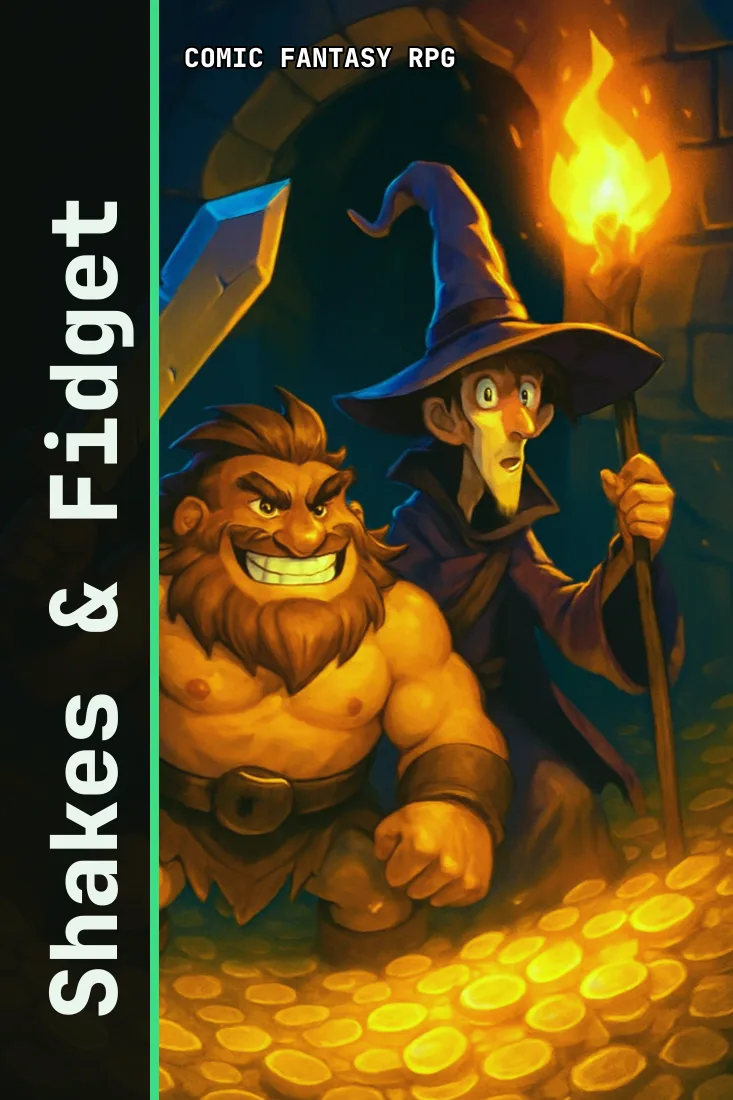
Shakes & Fidget began as a webcomic by Oskar Pannier and Marvin Clifford, poking fun at World of Warcraft and the whole culture of fantasy MMOs. Playa Games turned it into a browser RPG in 2009, and later brought it to Android and iOS. The humour survived the move intact: quest givers are ridiculous, item descriptions are sly, and your hero looks faintly embarrassed to be there.
Under the gags, though, is a proper RPG with a long reach. We expected a novelty and ended up checking on our characters over breakfast for months, plotting dungeon routes on the GO train and arguing about attribute splits in the group chat. It is the best game on our shelf for the player who has five minutes rather than an evening.
The tavern clock runs your day
The core loop is the tavern. You choose from a short list of quests, each with a time and a reward, and send your hero off. The quest finishes on its own while you do something else. Taking quests uses up a thirst meter, which refills each day, so the game gently caps how much questing you do and nudges you to come back tomorrow rather than burn out tonight.
That simple rule shapes the whole game. Shakes & Fidget never asks you to sit at the screen; it asks you to make a sensible choice, step away and return. Comparing the quests on offer becomes a small daily puzzle: a longer quest for more experience, or a quick one that gets you back sooner? It is a design that respects a busy life.
Twelve classes, eight races, five numbers
Character creation offers twelve classes and eight races, and the classes really do play differently. The Druid shifts into bear, tiger or eagle form; the Berserker can chain several attacks in a single turn. Races add their own bonuses and penalties, so even the first screen asks you to think a little about what kind of hero you want.
Growth runs through five attributes: strength, dexterity, intelligence, constitution and luck. Which ones matter depends on your class, and spending gold on the right attribute at the right time is the main strategic decision of the early game. It is easy to grasp and surprisingly hard to master once the arena and harder dungeons start testing your choices.
Dungeons, a tower and a very long road
At level ten the dungeons open, and they are the game’s backbone: a long list of themed locations, each a ladder of opponents to beat one at a time, most of them dressed in the same cheeky humour as the tavern. Progress is slow and steady, and every boss you finally topple feels earned.
Clear the first nine dungeons and the Tower appears, a hundred fairy-tale encounters stacked one above the other. Much further on there is still more for high-level heroes. That depth is why Shakes & Fidget scores well on build depth despite its simple surface: there is always another floor, another boss, another reason to rethink your gear.
Arena rivals and guild mates
The arena pits your hero against other players, with fights resolved automatically from your stats and equipment. It is quick, and it is where you find out whether your attribute choices were wise. A loss tells you exactly what to fix; a streak of wins is a pleasant reason to check in.
Guilds add the social layer: you can join friends, fight alongside them in guild battles and share in guild progress. The shop is present here too, and spending can speed things up noticeably. Still, our free heroes made steady progress through dungeons and the Tower, and the thirst limit applies to everyone, which keeps the field more level than you might expect.
Seven sunrises in Shakes & Fidget
- Read the class list carefully and pick one whose mechanic amuses you; the Druid and Berserker are good first choices.
- Check the tavern three or four times a day, comparing quest times against rewards rather than always taking the longest.
- Put early gold into your class’s main attribute and constitution before anything else.
- Reach level ten and try the first dungeon; note which opponent stops you and what that says about your build.
- Join a guild by the end of the week and ask members which attributes they would raise next.
What wore thin
- Fights resolve themselves, so action fans may feel like spectators.
- The shop is persistent and spending clearly speeds things along.
- Later dungeon floors can stall for days without the right gear.
Reasons we lingered
- Genuinely funny writing that stays sharp well beyond the opening hour.
- A dozen classes with mechanics that change how fights resolve.
- Thirst-limited questing that fits perfectly around work or school.
- Plays the same on a desktop browser or the mobile app.
Who will settle into Shakes & Fidget
Shakes & Fidget is for the player who wants a long RPG in tiny pieces: a check at breakfast, another at lunch, a dungeon attempt before bed. It suits anyone who enjoys parody and a stat puzzle, and it works well for people who move between a laptop and a phone.
Tamarack’s last word on Shakes & Fidget
Shakes & Fidget proves a joke can carry a game for years if the game underneath is sound. The tavern clock is a clever, humane pacing system, the class list is far richer than it first appears, and the long ladder of dungeons and the Tower gives real staying power. It is not a game you play hard; it is a game you live with, and it is very good company.